Still playing it safe with your pricing? This post dives into the mindset behind underpricing and shows you how to charge with confidence and real strategy, so you finally earn what you’re worth.



If you’re still charging what feels “safe” instead of what reflects your true value, it’s time for a change. This post unpacks the mindset blocks behind underpricing, then walks you through how to price your services strategically, confidently communicate your rates, and stop leaving money on the table.
Get ready to discover:
- Why solopreneurs underprice their services
- A step-by-step guide for pricing services effectively
- 4 smart pricing strategies
- How to communicate your value with confidence
- How to keep more of what you make
Why solopreneurs underprice themselves
1. Imposter Syndrome
Reason: They doubt their own value.
Explanation: Imposter syndrome affects up to 82% of people at some point. As a solopreneur, where you are the business, these doubts hit harder. The fear of being “found out” as not good enough can quietly influence how you price your services.
This leads to:
- Setting prices based on fear instead of real value
- Burnout from overdelivering and undercharging
- Attracting clients who undervalue your expertise
2. People-pleasing and fear of rejection
Reason: They want to be liked and avoid discomfort.
Explanation: Many solopreneurs develop close, friendly relationships with their clients. Saying a price that might be “too high” feels risky. They fear damaging the relationship or scaring the client away. So they undercharge to keep the peace.
This leads to:
- Serving clients who expect premium work at bargain rates
- Struggling to enforce boundaries or say no
- Feeling resentful and overextended
3. Lack of pricing framework
Reason: They guess instead of using strategy.
Explanation: Without a clear system to set rates, solopreneurs often base their prices on what they think clients can afford or what others are charging, without factoring in their own costs, goals, or the value of the outcome they deliver.
This leads to:
- Inconsistent income
- Difficulty forecasting or planning ahead
- Constantly asking, “Why am I working so hard and still broke?”
4. Comparison trap
Reason: They base their prices on what others are doing.
Explanation: It’s tempting to peek at what other designers, coaches, or service providers charge and assume that’s your benchmark. But without context—like their overhead, experience, or client base—it’s a false comparison.
This leads to:
- Second-guessing your own worth
- Ignoring your unique strengths and results
- Making business decisions that don’t serve your long-term goals
5. Fear of losing the sale
Reason: They believe lower prices = more clients.
Explanation: Especially when business feels slow, it’s easy to think the solution is to lower your rates. But that can backfire, discounts don’t guarantee conversions, and they can actually attract less committed clients.
This leads to:
- A race to the bottom
- Less profit with more work
- Clients who question your value or ghost you after quoting
6. Emotional pricing habits
Reason: They let feelings (not facts) drive pricing.
Explanation: Money is emotional. Maybe you grew up believing that making good money means you’re greedy. Or you worry that charging “too much” makes you selfish. These beliefs sneak into how you price, even when you don’t realize it.
This leads to:
- Undercharging to feel morally “good”
- Avoiding high-paying opportunities
- Staying stuck at a revenue ceiling you can’t break through
How to price your services the right way
Here’s a step-by-step guide to pricing your services effectively, so you can grow sustainably and pay yourself consistently.
Step 1: Know how much you need to make ends meet
Start by calculating your Minimum Viable Rate (MVR), the absolute lowest you can charge while covering your needs.
Use this formula:

Let’s say you want to make $5,000/month. Your business expenses are $1,000/month, and you set aside 25% for taxes. You work 20 billable hours per week.
Calculation:
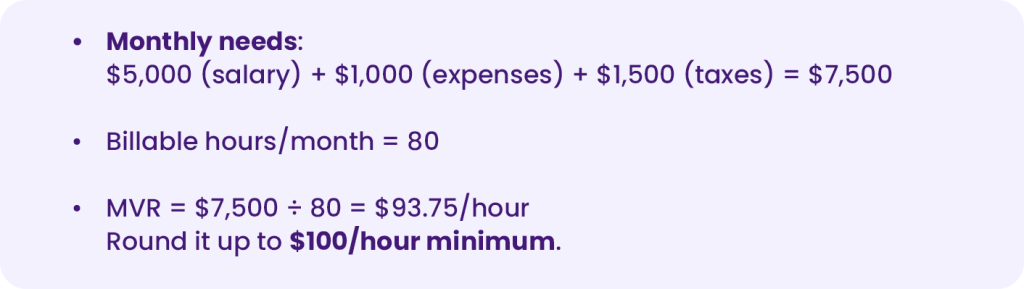
Round it up to $100/hour minimum.
Now, price above that to account for profit and positioning.
Step 2: Switch from hourly to value-based pricing
Now layer in the value of what you provide.
Ask:
- What problem does this solve for my client?
- How much time, stress, or money does it save them?
- What revenue or ROI might they earn from it?
Example: A $1,000 sales page that helps sell a $10,000 course isn’t expensive, it’s a bargain.
- Hourly pricing says: “You get 3 hours of my time.”
- Value pricing says: “You get a brand strategy that converts browsers into buyers.”
Value pricing aligns your rates with the transformation you create, not just the time you spend.
Step 3: Turn your services into signature packages (that sell themselves)
Service packages let you price based on value and scale with ease.
Let’s walk through an example: You’re a brand designer.
Here’s how to package your services like a pro:
Create a Signature Offer
Create a clear, outcome-driven package like:
The Brand Boost Bundle
Includes: logo design, color palette, brand typography, and a mini brand guide PDF.
This positions you as a results-focused expert, not just a pair of hands.
Offer Tiered Options
Give clients a choose-your-own-adventure experience with 3 levels:
| Bundle | Price | What’s included |
| Starter | $750 | Logo + color palette |
| Signature | $1,500 | Full Brand Boost Bundle |
| VIP | $2,500 | Everything in Signature + social media templates + brand strategy call |
This makes your mid-tier package look like a sweet deal while serving clients with different budgets.
Use add-ons to upsell (not discount)
Instead of lowering your price, offer add-ons like:
- “Need business cards too? Add them for $200.”
- “Want rush delivery in 3 days? Add $300.”
This keeps your core pricing firm while increasing your revenue per client; win-win.
Hot Tip! Packages also make it easier to forecast income, plan your workload, and confidently say your price, because it’s tied to a clear transformation, not just hours on a clock.
Step 4: Benchmark strategically
Do market research to get a ballpark range, not a blueprint. Look at what others in your niche (and at your skill level) are charging. Use sites like Clarity.fm or Fiverr, browse service-based directories, or search “[your service] + pricing” to gather insights.
But here’s the key: don’t fall into the comparison trap. Just because someone charges less (or more) doesn’t mean their rate is profitable, sustainable, or right for your model. You don’t know their overhead, experience, or business goals.
Use competitive research as a starting point, not the final say. Your pricing should reflect your value, your outcomes, and the real costs of running your business, not just what the next person on Instagram is charging.
Quick gut-check! If the price you’re thinking of makes you feel slightly uncomfortable but still confident, you’re probably on the right track.
Step 5: Test & adjust
Start with a confident price, then:
- Raise it by 10–20% with every 3–5 new clients
- Survey past clients about perceived value
- If you’re fully booked, it’s a sign to increase your rates
4 smart pricing strategies that work (and how to use them)
These four strategies will help you price smarter, communicate your value more clearly, and stop undercutting yourself.
1. The Anchor Method
Use pricing psychology to your advantage by offering three tiers and making the highest one a deliberate outlier.
How it works: Introduce a premium, high-ticket option to make your mid-tier package look more affordable by comparison. This is called “anchoring,” and it works because buyers subconsciously compare the middle tier to the highest one, not the lowest.
Example (Brand Designer)
- Starter: $750
- Signature: $1,500 (most popular)
- VIP: $2,500
Even if most clients choose the Signature package, the VIP option makes it feel like a great value.
Hot Tip! The high-ticket option doesn’t need to sell; it needs to set the stage.
2. The 3x Rule
This one is part mindset shift, part business reality check.
How it works: Determine your minimum hourly or project rate, the absolute lowest you’d accept and still feel okay. Then multiply it by three. That number accounts for taxes, software, downtime, admin, and profit.
If your bare minimum is $50/hour, your real rate should be $150/hour.
Why? Because you’re not just paying yourself, you’re funding your business, your future, and your peace of mind.
Use it to: Price packages, estimate retainers, and quickly gut-check new offers.
3. Avoid the Sliding Scale Trap
Offering “flexible pricing” sounds generous, but it often becomes a fast track to burnout and resentment.
How it works: Only offer discounts for intentional, strategic reasons:
- Beta testing a new offer
- Giving back to a specific community
- A pro bono client you truly want to support
- A holiday or special occasion (a.k.a Black Friday)
Otherwise, stick to your rates. If someone can’t afford your services, point them to a product, course, or free resource instead.
Remember: Discounts should be a strategic decision, not a default response to discomfort.
4. “Pick Your Problem” Framing
This is a powerful way to shift the conversation from “how much does it cost?” to “what’s the cost of not doing this?”
How it works: Frame your pricing in terms of the pain you solve or the time you save. You’re not charging for the deliverable; you’re charging to eliminate frustration, confusion, or wasted hours.
“You can spend 10+ hours trying to DIY your brand, or invest $1,500 to have it done right the first time.”
Use it in: Sales calls, proposals, or website copy to anchor the price in results, not effort.
How to tell clients your price without flinching
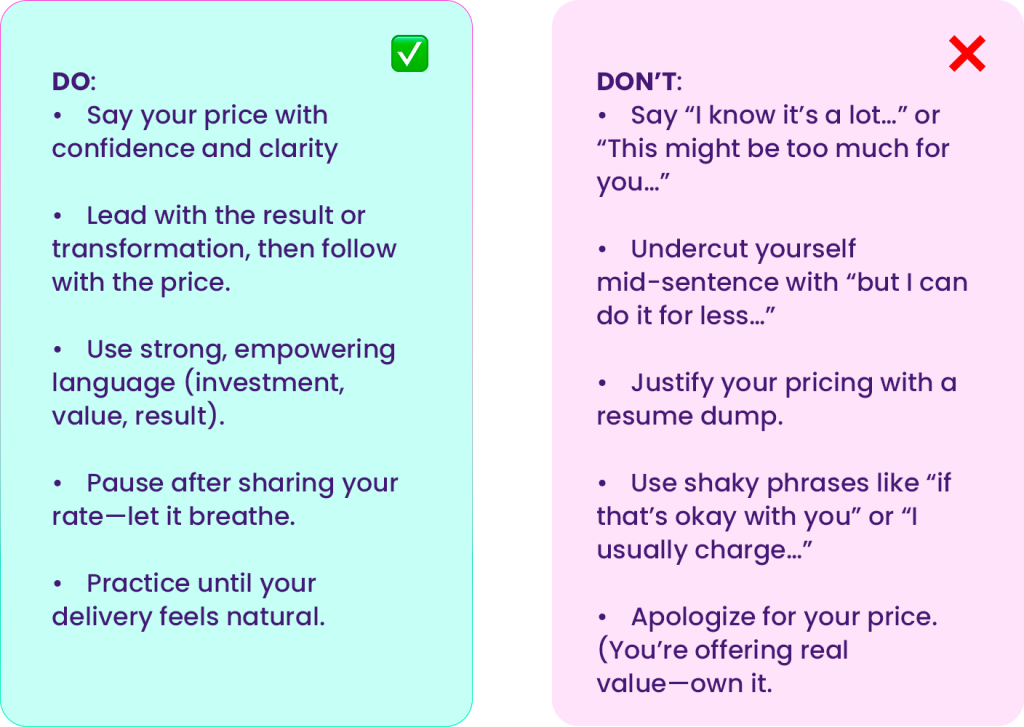
1. Use the “Value Sandwich” Formula

“This strategy will give you clarity on your ideal client, messaging, and offer positioning. The investment is $2,500. Most clients report doubling their inquiries within a month.”
2. Use empowering language
Words matter. Swap:
| From | To |
| “It costs…” | “The investment is…” |
| “I charge…” | “Clients typically invest…” |
This subtle shift makes your offer feel like a partnership, not a transaction.
3. Hold the silence
Once you state the price, stop talking.
Let the client process. Don’t rush to fill the silence or talk yourself into a discount.
Pricing Dos and Don’ts
Real talk: Raising your prices
- Start with new clients: No explanation needed. New rates apply moving forward.
- Offer advance notice for existing clients: “Starting July 1, I’ll be raising my rates. You can lock in current pricing by booking in advance.”
- Communicate your value growth: “I’ve added new systems, tools, and insights to make your experience even more streamlined.”
You’re not expensive, you’re worth it
Undercharging won’t win loyalty; it will cost you time, energy, and confidence. It might even cost your business. When you price with clarity and conviction, you attract clients who respect your work and value your expertise.
You’re not just “providing a service.” You’re changing lives, growing businesses, and solving real problems. Price accordingly.
Why solopreneurs use Cashflowy to keep more of what they make
If you’re done guessing your rates and hoping for the best, Cashflowy’s got your back. Aside from handling all your finances for you, our AI-powered Financial Coach shows you exactly how profitable you really are, gives you advice on how to increase your profit and reduce your workload, all that based on your results.
Here’s how Cashflowy helps you stop underpricing:
- Breaks down your real-time net profit (no math needed)
- Highlights where your money’s actually going
- Shows you how to reduce your workload and increase your profit
Stop second-guessing your pricing and start making confident, profitable moves.
Try Cashflowy free today and let our AI financial coach show you exactly how to grow your income, cut the busywork, and finally pay yourself

Frequently Asked Questions (FAQ)
How do I know if I’m underpricing my services?
If you’re booked out but barely profitable, feeling resentful, or constantly being told you’re “a steal,” that’s a red flag. Check if your prices cover your time, taxes, expenses, and a profit margin. If not, it’s time to raise them.
What’s the best way to raise my prices without losing clients?
Give clients advance notice (30 days is standard), reinforce the value they’re receiving, and frame it as a natural business evolution.
Try: “As I continue to grow and improve my offerings, I’m aligning my rates to better reflect the results I deliver.”
How do I figure out what to charge as a solopreneur?
Start with your income goal, add in business expenses and taxes, then divide by your capacity (hours or clients/month). This gives you a baseline to build value-driven packages.
Should I charge hourly or per project?
Project-based pricing is usually better. It rewards efficiency and focuses on results, not clocking in. Hourly rates can limit income and create scope creep.
How do I price my services when I’m just starting out?
Start with a fair, sustainable rate that reflects the transformation you provide—not just your time. You can offer a “beta rate” to get testimonials, but set a date to increase it.
What if a potential client says my prices are too high?
That’s not necessarily a red flag—it means they need help understanding the value. Ask clarifying questions about their goals and reinforce the outcomes your offer delivers. If it’s not a fit, that’s okay too.
How do I deal with pricing comparison to competitors?
Competitor research is a reference point, not a rulebook. Focus on your value, your niche, and the specific transformation you provide. You’re not trying to be the cheapest—you’re aiming to be the best fit.
Can I still be “accessible” without discounting?
Yes! Use payment plans, group offers, or self-paced products to create accessibility. Discounting your core services often backfires and undervalues your work.
How do I explain my price to clients without sounding salesy?
Focus on the results, not the deliverables. Say:
“This investment saves you 10+ hours/month and helps you book more clients with a professional brand—so you can grow without burning out.”
Is it okay to say no to a client who can’t afford me?
Absolutely. You’re not for everyone, and that’s a good thing. Offer them a smaller package or a helpful resource, but don’t compromise your sustainability.
 Cashflowy vs Other Tools: Which One Fits Solopreneurs Best? - Xero, FreshBooks, QuickBooks, and Wave are big names, but are they built for solopreneurs? Here’s how Cashflowy compares to each competitor and why it might be your perfect fit.
 The 5 Business Metrics Every Solopreneur Needs to Stop Wasting Time (and Start Growing) - Discover the 5 essential metrics every solopreneur needs to stop wasting time, boost profits, and access a free KPI guide—no spreadsheets required.
 Tired of Hearing “Let Me Think About It”? Try SPIN Selling Instead - Stop guessing what to say on sales calls. Learn how to use the SPIN Selling framework to ask better questions, close more clients, and never sound pushy.